See Full Transcript
I'm gonna get a bunch of cultural things wrong with this little anecdote, so I'm sorry.
We heard the last one.
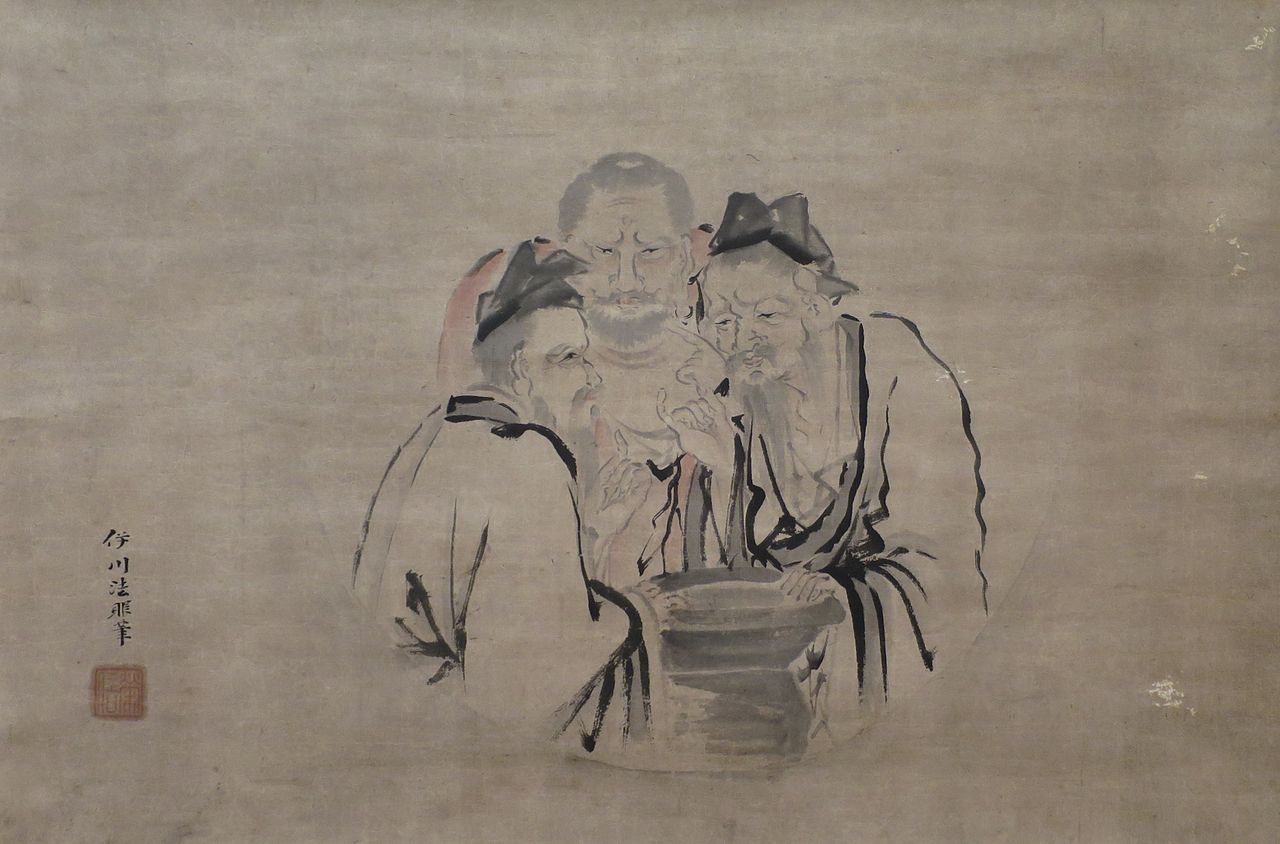
Thanks, Doug, thanks for listening. There's this Daoist concept, a Daoist painting called The Vinegar Tasters. There's these three guys around a pot, right?
And one of them is grinning, and one of them is frowning, and one of them looks contemplative. And there's a pretty good way of looking at all of life.
You could be the person who hates everything, the person who only finds joy, or the person who likes to consider, and regardless of whether it's something good or bad, at least learn from it, right? Usually, I try to be the contemplative person.
In a lot of things, I'm the grumpy guy. But for this, I was the grinning moron. I just loved these wines.
Awesome. Oh, good.
That's really cute, Greg.
Yeah, right? It's easy to impress me these days. I don't know what happened.
So there you go.
It's a good thing you're not our buyer.
Roll the music. Let's see if this thing started. You're listening to Barrel to Bottle, The Binny's Podcast.
I'm Greg, I do communications at Binny's, and in the room with me, socially distanced, of course, are some of the greatest wine minds in the retail industry, wine industry, and also me.
I'm Alicia, I do wine education.
Doug Jeffers, director of wine sales.
I'm Bill Newton, one of the buyers.
Barbara Hermann, wine director.
And you guys have all been on the podcast before, right? Everybody here has been on the podcast before. Okay, cool.
Then we don't have to go over the ground rules. And we are talking about 2018 Bordeaux, because we had this event, right, Doug?
We did. We just received samples from the Union de Grand Crude of Bordeaux. They sent us 50 cases of samples from the 2018 vintage.
So we gathered our wine people together and went through every last one of them.
Fifty cases. How many locations?
We did this in six different locations.
So we sent the tasting line up to stores all around Binny's land and then our wine managers and wine consultants could get out and taste them all?
Correct.
And also I snuck in.
Yeah. We let you. Even downstate.
So we saturated the market pretty well.
They prefer to be referred to as Central Illinois.
Mid-state, Central?
So we got a taste of the 2018 Bordeaux, pretty much the whole line up. This is important, I think, because of COVID times, what's going on right now.
We had to break it out into these individual location tastings, and there was no consumer component the way there has been before. But that is, I think, one of the wine tastings that I look forward to the most out of all of them. You guys agree?
Anybody jump in at any time.
It's the one tasting that I tell every wine person, if there's one tasting not to miss, this is it.
So we've been partnering with the Union de Grand Cru for the last many, many years for a, they do a trade event at the Drake downtown, and then we partner with it directly after that for a consumer event.
We open this up to our customers, which is great.
And it's an opportunity for the industry people to find out what they want to buy and then also get a taste of what they're going to sell to people who are interested.
And customers, really, this is for like, your hardcore fans who are going to sell Bordeaux, and then investors who are investing in wine too, I'd say.
I think the consumer vent draws everyone from the casual Bordeaux drinker through to the investor, no doubt.
But I think it's also really important that we are tasting this vintage because oftentimes, if you just read reviews of Bordeaux, it seems like every vintage is declared outstanding. And because of its location, it can have great vintage variation.
And so understanding the differences in the expressions each year is really important, especially for those people that are thinking about how to lay down the wine and when to open it.
That's true. Hey, Doug, remember that time I forgot the scanners?
Yeah, that was just one of the times my head exploded.
Right.
But no, let me say that that is one thing I've noticed with the tasting we've done every January for the last probably eight or 10 years is that for the consumer event, it used to be just suits.
It was older guys, guys buying Bordeaux, and it was pretty serious. Now it's a much more fun event. A lot wider range of people, consumers, even people new to Bordeaux, which is great to see, especially for this vintage.
I think it's a great vintage for that new consumer.
Over the years, I've noticed more date nights and girls night out kind of groups at UGC, which is cool to see them.
It's been more of that.
It's not just stuff shirts, right?
Yeah. Another thing about that tasting is and the timing of it is that for instance, like we were tasting 2018s yesterday and the week before, and this is when they are going to start coming into our stores. They're getting shipped over.
So these are wines that were for sale close to two years ago.
Futures.
Yeah. As futures as very young wines in Barrel. Now they're finished and they're being shipped at this point.
So how much of the vintage do we have now?
We have a fair amount.
I mean, all of our stores, you're going to find some 2018s on the shelf. There's going to be more coming in. Also with any particular wine, we don't always get all of it in one shot either.
Correct.
Yes. Yeah. I buy it from multiple companies, negotiations, so it staggers while it comes in.
Just a couple of quick other things to say about the tasting is that if you buy Futures, it's a really interesting evening too.
It's going to be your first shot to see exactly what you bought.
Exactly.
If you like it.
Also, what Alicia was saying about various vintages too is, there could be a really what people say a great vintage, and it might not be a style that you're necessarily going to like, and that wouldn't be a vintage you should go long on.
But then there might be another vintage where some people would say it was okay, but it might be something you love. So everyone's taste is different.
So I think part of the reason that I was able to be the grinning guy who just enjoyed it is that you four taste a lot of these wines on a pretty regular basis, at least more frequently than I do.
I only really drink Bordeaux or taste Bordeaux when UGC is happening, because it's an opportunity to. So it's really hard for me to like have a continuity of like an understanding of the wines from year to year and each individual winery.
When I started this tasting, I just kind of, I admit I just kind of dove in and did a very quick tasting of several communes as quickly as I could, just to get an impression of the vintage. And that was like, what was the first day?
In terms of the communes we tasted through?
Yeah.
Yeah. We went from basically San Estef downwards. We had San Estef, Poyac, San Julien, Margot.
Certain people did Pesac, but.
Oops.
So I tasted Margot and I tasted Poyac. And then I got to Saint Julian. And I tasted some of Dacthu.
And then I got to St. Julian and I was like, oh wait, this is good. I need to take notes.
And it really lit me up. That was where I got excited. And that's when I started taking notes and actually trying to like dive into each wine at a little deeper level than just tasting a grass.
But it's so hard when it's, when there's so few frames of reference, you know, when it's just a snapshot of wines in their primal youth once a year.
So how many wines were you into the tasting before you decided it was a good tasting?
And turned into the grinning idiot who just enjoyed it? Yeah, right.
Kind of the irony in what you're saying is that here we're really tasting wines in a whole group of wines, where there is a lot of history and a lot of consistent style behind them.
So yeah, I mean, probably nobody's making wine like they did, you know, 30 years ago or 40 years ago or maybe even 20 years ago. They've all made improvements in their cellars and in wine making technique and in viticulture and that.
But, you know, that A Chateau of G score is still going to be G score and there's got a big history behind it and a certain style to it or Lynch Bosch as another example. It's not like you're walking into these tastings and it's a total blank slate.
So that's why I feel like I'm a newborn infant that hasn't been crushed by life experiences yet.
And that's why I'm really interested in hearing what you guys have to say in the context of Bordeaux at large, especially across the last couple of decades. So I think it's going to be a fun dive.
I thought one of my first impressions of this vintage, when we were doing the left banks was, and also Pesach, is that a lot of the wines that are not the most expensive wines, I thought were outstanding.
I thought there were some really, really good wines that fought way above their category.
Is that because they're more designed for earlier drinking, so they're more approachable or is it a stylistic thing?
I think that, I don't know. I would have to taste them again as time goes on. But for right now, it just, it seemed like the weather conditions probably really suited certain areas better than others.
And I think it was a little bit of a crapshoot in certain circumstances.
Just the vintage.
I know, I know that there were certain estates that had some problems. So yeah, I just think it was one of those things.
As we go through the various areas, I think we'll be able to give recommendations to people about some wines that are really, really good for the money.
Barb, what do you think of the vintage?
I think it's really, it's truly excellent. I mean, it kind of reaffirmed like a lot of the early hype about this, you know, when the wines first came out on Futures. You know, the first part of the vintage was really very, very difficult rain wise.
They had a lot of, they had a lot of rain, they had a lot of moisture, they had a lot of mildew.
But then starting towards the end of July, the weather became incredibly dry for the rest of the whole harvest season, the whole growing season, and it was very, very, very warm.
You know, I'm sure they've learned a lot of things since 2003, because you don't, I didn't experience like baked wines or anything like that.
There's some, a little bit of surmaturity, but there's a lot of right, just really big lush ripeness and the acidities are very good. They're not, there's not like flabbiness in these wines.
That's key, right? If it's too warm and then all the sugars mature and the acidity also matures too much, then you just end up with big sweet wines. Was that the case in 2003?
2003 was a notably hot year, right?
It was extremely hot year in Europe. That's when they had all the deaths and things, thousands of that, and it was very extremely dry.
I mean, I think when I was tasting the 2003s, I don't really remember saying, oh, these are, they're not, they're raisiny or anything like that. They were just extremely flamboyant at that time.
Honestly, after coming up, being the vintage after 2002, that was a really good thing to taste, you know, because 2002 was a little bit on the meager side, you know.
I think the other thing I was surprised about, because I was also going in, hearing about especially warm and warm temperatures and a dry second half of the summer, thinking that we would get some more alcohol and some pretty kind of boozy warm
wines. And I didn't see that. And you're right, the acid was in balance. And really the only one that I started to see a little bit of that was in Palmaral.
I think that was one that showed it slightly more than others. But on the whole, I think they did a really good job.
I'll say this, I definitely thought that St. Emilia was better than I thought it was going to be. It was not overripe at all.
I thought it had good acidity and had tannins and everything else. So there's more Merlot in St. Emilia than there is in the left bank.
And sometimes when it's really hot, the Merlot will get overripe. But I think this was a really good vintage for St. Emilia.
I like the St.
Emilia too. Chumped out. So what do you think, Doug?
Well, I was just thinking, as Alicia was speaking, it probably should be said that barrel tasting is really hard.
You got to put yourself in a different kind of mindset almost.
It's not like a regular wine tasting, and Barb travels to the region every year, and maybe you could just say something about how we buy, because we buy Bordeaux differently than we buy almost everything else.
That's correct. Normally, I have to buy things from wholesalers here, and they present me with something, or they present me with a piece of paper, and that's what I buy off of. But with Bordeaux, it is very different.
They want people, buyers all over the world, to come and try their wines. So in April of every year, except last year, they have a week-long series of tastings where you go and said, taste the wine that was made the previous year.
So if it happened this year, probably isn't going to happen. We would be tasting wines that were from the 2020 vintage. They aren't finished.
You're not really tasting out of Barrel. You're really tasting samples that have been pulled from Barrel, and you're either tasting them in a group setting with other of their peers, or you may go to the individual chateaus and taste the wines there.
I hear it's a fun and leisurely afternoon.
Not the way I scheduled my-
Barb makes it a slog.
Let me just say something about that. If anybody thinks it's fun, it's a joy ride, we're going to go to Bordeaux for a week to taste. Barbara Hermann is a machine.
She will put you on a schedule that is so grueling. Just a typical day, and I was lucky enough, I've been to Ampremiere and Bordeaux with her a few times, stood in for her there last year. With her schedule, no human can keep up with that.
There's no way.
Didn't you miss an appointment?
Two, yeah. They were rather pissed about it. But it starts off with a Nogossian tasting in the morning, so maybe you're 8 o'clock a.m., you go to Nogossian office for tasting of anywhere from 50 to 100 wines.
That's just the start of your day. Then you might get a quick lunch, and then you've got 10 to 12 chateau visits after that. And each one has probably six to eight wines for that.
So it's a real test in discipline. It honestly is. You have to be a professional to do it.
And that's why when I come back from a day, the first thing I have to have is a glass of champagne.
Champagne or beer.
We did beer.
Yeah.
I can only imagine how this sounds to the listener. No, but in all seriousness, even just the tastings yesterday and the week prior, it is a marathon for sure.
So Barb, tell us a little bit about the wines that we did taste of 18, and what you typically look for, especially structurally, to show promise for age, and what you might dismiss as drinking now versus, yeah, it's not actually that pleasant right
I would say a lot of these wines certainly are quite enjoyable right now, because they are so very ripe and very, very pure.
But based on history, you know that a lot of them are going to be drinking, you know, let's put this way, you would be able to seller them for 10, 15, 20 years, maybe 25 years, you know, with no problem, because all you have to do is go look and see
what you know, Smitho Lafite 2015 tastes like and Smitho Lafite 2010 tastes like. And then from the 2000 vintage, you know, in 1995, you know, this wine isn't going to collect, even though it may be utterly delicious right now, it's particularly if
you drink like, say, young California wines, it's not going to collapse in two years. This wine is going to hold for a long time. What do I taste for?
It's, I think I taste for, well, the first thing I really do is I smell the wine and I'm really looking for kind of a purity of fruit. And that's really different for obviously where it comes from.
So what, you know, a Pesachs, a great Pesach smells like is going to be quite a bit different than obviously a Wright Bank wine. And even the different wines will have a different characteristic.
So, you know, like the Carmel Brion has a lot of Cabernet Franc and it has like this almost like blueberry quality to it, real deep blue fruits, you know, and other wines from Pesach are much more tobacco-y or smoky and that.
So I'm kind of looking for the aroma that's kind of typical of that thing. And then I just hope that the flavor is going to like follow through.
So it's going to, you know, have a lot of generosity and I don't say richness, but it should have some really like real impact and roundness in the mouth.
You know, nowadays, I think it's been going on for so many, many years, but when you tasted these wines yesterday, I mean, there's very few where I really wrote down like that these were tannic, you know, because I think the, and this is true of like
top wine making, you know, like whether it's in Napa Valley or here, the ability to have really smooth, polished, soft tannins is quite remarkable. You know, these wines have backbone to it, but you just don't get slapped in the face or in your mouth
Yeah, that's definitely the reputation, is that they don't get better with age, but that they required age back in the day.
That's part of it.
Yeah, that's very true.
Speaking of Smith O'Lougheed, you want to try it? Because we happen to have a bottle open right now.
One of the favorites of this tasting, I think, has been, would have heard a lot.
That's another place where I'm more of a blank slate, because I know what happens to wine as it gets old, and I've had some old Bordeaux, but anything beyond that generality of how it gets a little more dry, a little more refined, how some of the
fruit eases up and it gets more autumnal. Outside of that, like in specific cases, I don't know how Smith O'Loughee tastes when it's 10 years old, or is it different than Les Combes in 10 years old?
Well, why don't you buy a couple of bottles and put them away?
Because I'm working on a Binny's salary here.
I mean, that's probably the single coolest thing about Bordeaux is it's all about pedigree. You know these wines, and if you have experience with these wines, it tells you so much.
I think if you understand Bordeaux, almost everything in the wine world is easier.
So do you get that purity of fruit?
Yes, I do. And a little bit of flamboyance too and richness too. It's a combination of this really ripe aroma, but there's a little bit of like tobacco in it.
And cocoa maybe.
And I absolutely agree that this vintage, I think in general, I would drink so many of these wines now.
I mean, they're not really intended for that. They're going to come together and they're going to be so much more, but they're delicious now.
Another thing that so many of the wines from this vintage is they have this like silky, silky thing.
That is exactly this wine.
Yeah. And this is a perfect example of it, but it's just they're beautiful. They're beautiful as far as that goes.
That's also another cool thing about this vintage is top to bottom.
I think there's there's really good quality and really good approachability. So even if you're brand new to Bordeaux, getting in some entry level 2018 is a good move. I think they're very good.
You guys want to do a lap around Bordeaux?
Sure.
Commune to Commune, let's go.
What do you mean, profile or just we're just going to talk about?
We could start with Paysak since we're tasting one.
Because actually what I was going to do is just point out that. So Smith Al Lafitte is considered probably one of the three or four best wines out of this Commune, I would say. Yeah, for sure.
It's definitely at the top.
We really had a large good assortment of the top producers, very top producers in Paysak.
One thing that I was interested in, Paysak was one of the areas that I thought that there were some wines that were really, really good, that were not like crazy expensive too.
So there's one wine that I know that it's called, and Barb can help me with my pronunciation, Latour Matariak?
Oh, Latour Martiak.
Latour Martiak. So I loved this wine just to tell you the truth. It was silky, it was intense, there were tobacco flavors.
I said it had zippy acidity, which is exactly what it had. And we have half bottles of this in our stores right now, like $21, $22, and we're going to be getting $7.50 as well.
So if you're wondering what this commune is like, and you want an example of that, and you don't want to spend $120 on a bottle of Smith-Alt-the-Feet or whatever it costs now, this would be a great place to start.
Also, it's very fun to drink now, but it is something that you could keep for 10 or 15 years. So get a half bottle, drink it with dinner, and get a regular size bottle and put it away for a while.
Now the real story. Come on. Bill and I tasted this together, Le Tour Mardiac, and he goes, this is so good.
Look, it's only $22.
That is true. That was the half bottle. But we're getting the $7.50 also.
I had good marks on that as well, and I thought it showed really beautifully, but I also thought it really kind of packed a punch.
I think it will integrate and definitely last a while. The other one I loved from Pesach, which I will agree was just, I thought it was a solid representation, and there weren't many wines that I dismissed as being quite poor.
But the Les Carme Aubrillon, I thought was really beautiful. I thought it was very well balanced and had great freshness of fruit, so I really enjoyed that.
Fresh is spot on on that one. Yeah.
Yeah, I was just going to say, I think this commune showed really, really well. And one of the things is that it was almost all the wines were very, very aromatic.
And I think that's kind of typical when it kind of indicative of this commune, because wines from Paysac with some age on have almost kind of like a haunting aroma to them. Sometimes if you're not used to it, it's almost a little bit off putting.
It's a little strange because it's not very Cabernet, very strong like that, but it has, like I said, the smoky, almost tobacco sort of scent. And it's pretty, I find it extremely attractive.
And these wines have a little bit of that and still a lot of those cherry and more fruit-driven flavors at this time, but they were still really showing well.
I know what you're talking about. I love when I put in a note, ethereal. And if you can just keep getting those different nuances in the smell, that's a winner.
Did you guys, Chateau de Fuisel, Fusel?
Fusel.
Fusel?
Fusel.
Okay.
Tell me that's less expensive.
Yes, I don't know exactly what the price would be. I would say maybe $50, I'm just guessing.
I liked it because it seemed more approachable now. I mean, these are all really primal, but this one seemed a little on the lighter side. Orange peel, cola finish, which is not so heavy handed to some of the others.
Yeah, I thought this was pretty herbal and kind of plummy, a little bit of spice.
Yeah, I thought it was a solid wine.
It's funny, I said cherry cola nose.
All right.
And I said kind of reminded me of a Ridge Zin.
Yes, yes, that's a Barber favorite. Team Barb.
That's just one, Greg.
We'll get to your last come later on, Greg.
Right, cool. Any other standouts in Pessec, Lyon, Lyon?
Pessec, Lyon. The top wines, really are the top wines. I think obviously like Smith Hold of Feet, Pop Clément, Malartic Le Gravier, Carme Auberion, but I thought like Auberge, and same thing, Larvae Auberion were just really, really outstanding.
I didn't see Picaillou this year.
I think they were not there.
No.
But that's traditionally one of my favorites, one we pick up an awful lot. We get most every year and borders right up against Auberion, I think.
Kind of. It's sort of on the real close. It's pretty close on the few blocks away, I think.
Let's go to Margaux.
Margaux.
Work our way up, yeah?
Love the Margaux.
So that's more Cabernet, right, Left Bank?
It is more Cabernet, and it is Left Bank.
It's, I think, the first commune going north of Bordeaux, isn't it?
Well, yeah, I mean, it's the first of this. The city of Bordeaux. Yeah, I mean, before that, you get into Omadoc.
Omadoc's all over the place, but there's Omadoc. Like, Lanneson is actually very, very close to the bottom edge of Margaux. And it is more Cabernet, for sure, but it's not necessarily a lot of Cabernet.
For the Madoc, it's a big Appalachian. It's spread out a long way. And this is actually an area where in the past, a lot of the ground is pretty low, and it's pretty close to the river.
And they used to have all kinds of drainage problems. Some of the chateaus have spent a lot of money rebuilding drainage and bringing everything up.
And this is also an area where we didn't have the wine yesterday, but Chateau Palmer, the very famous third growth, is now biodynamic. And they lost almost their entire crop because of all the mildew in the early part of the year. Right.
Same thing with Ponte Cana.
At Ponte Cana, they said July 14th, it was beautiful. Everything was perfect. July 15th, they lost more than half their crop.
So rain, rain, rain in the first half of the year, lots of moisture, lots of saturation in the ground.
And then the rain stops, as Barb said, mid-July, and the temperatures came up, and the mildew just spread like wildfire through the vineyards, and just you can't stop it. And being organic biodynamic, you can't just go out there and spray to cure it.
So they're like, why are we organic biodynamic?
Right, so they're all looking at each other like science guys? No, let's take a pass next year. We'll get them next year.
I think I shared this in our wine manager meeting recently, but the average yield in the Medoc is about 45 ish, hectoliters per hectare.
And Chateau Palmer this year was at 11. Ponte Canet was at 10. So they lost, I mean, they lost so, so much.
And to Doug's point, while we all, of course, want to cure for the land, when you lose that amount of fruit and you can't do anything about it, I'm sure it's pretty painful. But let's talk Margot.
Margot.
Doug was a big fan. And there were some that I enjoyed, but it wasn't my favorite of the communes.
I think it's one of my favorites typically, so probably have a little bit of a predisposition toward it. It's also known for being one of the more soft styles of the left bank of Bordeaux.
I think it also has the most classified growth, but it's also home to the famous Chateau Margot, first growth. One that stood out for me that I liked, it was rather controversial, was the Chateau Les Combes. Yeah.
I liked Les Combes.
I mean, Les Combes was actually kind of a little like not tip, maybe, you know, textbook typical of like, if you just read this quick paragraph about Margot, because it was actually quite oaky and quite new oaky and quite rich, and it was kind of
very delicious in a very flamboyant way, whereas I think some of these others showed more of like the Margot topicity, you know, like Demi-Rai and Kirwan. I think they had the very seductive, more elegant aromas to them. Right.
I loved it for that reason. It was really overt. It stood out in this big tasting.
I know Bill didn't like it, but for me, I liked it because of that reason, big oaky roasted coffee kind of nose, and it was really, really interesting.
I think that's why it caught my attention.
Yeah, not a lot of subtlety though, right Bill?
That's right. That was kind of obvious, but I really liked the Kirwan. I thought it was really, really good.
It seemed more approachable and easier to get into right now.
I liked Boyd Cantonec.
I thought it was really, really interesting. It was almost like some leathery licorice thing going on with that wine that I really liked. Ras en Seglas, I mean, that was a beautiful wine.
Yeah, I agree with you on that.
Interesting, the first thing I wrote was actually delicate and silky. So quite different from what you expect out of this vintage. But I think quite a few of these wines were that way.
I mean, they certainly weren't like the Margot's were really fine in 14, but there you really see this kind of almost like delicacy and kind of mint, leafy, herbal qualities come through because of the vintage.
And here, they are a little bigger and they're a little richer, but they still have this refined quality to them.
There were several that I kept coming back to this like roasted coffee, roasted nuts quality to it. The Las Combin, definitely one of those. And the oak just seemed very heavy handed to me and not what I expect to have when I go to Margot.
And I just want to second what Bill said. I feel like I'm right with you. Kirwan, Demi Ry, which Barb mentioned earlier, and then the Roast nuggets, they were absolutely phenomenal.
All right, where do you want to go next?
Right up the road, that is St.
Julien.
Yeah.
St. Julien.
So St. Julien is just up the road from Margaux, and it's the smallest of the communes in the Madoc, of the classified gross. And we were very lucky.
I mean, we had a selection of really outstanding chateaus.
I guess maybe if you asked me what really was my favorite commune, I think dollar for dollar, it's this one, but a lot of it has to do with the fact that we were really just tasting a bunch of stars.
It was the good stuff, right? This region just lit me up. I just opened up right here.
If you look at the old wine writers, they'd say hi, when they describe Bordeaux, like Saint-Julien, it would always be like four square.
So a lot of these wines are like that. Some of them very, very full and square and rich in that style.
She's trying not to say masculine.
The thing was, it was a perfect vintage for that. I just thought that these wines were, I mean, I thought La Grange was amazing for the price. It was a really, really good wine.
I thought the Brunère was a beautiful wine. Saint-Pierre was very good. I mean, it was almost like you couldn't go wrong in Saint-Julien.
I would agree with that.
When I started out with the Béchamel, I was just so, I don't want to say surprised, but just in love with it.
And then the Brunère de Crude that followed, they all had these really lovely aromatics to me that were kind of floral and perfumed and this kind of earthy woodiness going on alongside all this fruit concentration.
But they were really elegant and showing well.
You know, when you look at, sometimes I think it's been, I don't know, talked about maybe that like in a very ripe vintage, like everything will end up kind of start tasting alike because they're all, everything's so ripe.
But when I was tasting the Margot's, I'm thinking like, yeah, these smell like Margot. And then boom, you know, we start tasting, you know, the first group of St. Julien's.
And it's like, this is, we're in a whole different commune now. There's no similarity in style. And then, you know, now we're going to go into Poyac next.
And that's a whole another animal. I mean, there's nothing. I mean, in some ways, they were all very textbook.
Yeah, which is a great sign because it does.
It means they're not overripe. They're showing exactly the way they should show.
Is it hacky just to say that I like the Poy for a ton?
No, it was it was really good.
Really good, right?
It was really good.
Yeah, hacky, like kind of obvious.
Of course, it's just now it was really good. And actually, the Gouraud-le-Rose, I thought was really, really good, too. Probably the most modern of that wine I've ever had.
But I agree with that.
I've had Gouraud-le-Rose and Béchamel. I don't want to say I've written off, but I never think of them as standing up with their peers quite, quite as tall. But tasting both of those, I was like, wow, I can't forget about these wines.
These are really good.
My number one was Liable Barton, so I'll put it in for her. That just had this beautiful quality of fruit and vanillin, velvety and pure.
Perfect.
Those are great selling words.
Overall, we're big fans of Saint-Gilien and 18.
A big star. All right. Moving down the road farther.
Poyak?
I love this table. I thought Poyak was big and expressive and generally needed a lot of time, but awesome wines.
I was overwhelmed. I thought this monolithic, hard-edged, impenetrable wall.
Well, that's very true. And that's classic Poyak.
All right.
And we got some, a couple of wines here for sure that would, are very classic in that style.
I mean, you've got Lynch Bage, which is always like big and big, powerful, you know, and Pichon Baron, which usually shows a lot more ripe fruit and a little more of that kind of flamboyance early on was that, you know, and its neighbor Pichon
Lalonde, which is actually quite a bit more elegant in style. And it's put on a little bit more weight, but that was really, that might have been, that was definitely one of the top wines in this group.
That was a really interesting wine too. The finish on that was like long and just different from any of the other wines at the table. That was, that was a really good wine.
The other one that stood out to me was the Duart Mille.
I thought that was exceptional.
Yeah, we had three wines in this flight that were made by First Gros. So they know how to make wine and they're not going to put out an inferior product with their other properties. So it really shows and they really show a lot of breed.
It was like Clermion and Darmioque and then the Duart Mille. I mean, really had a lot of class to that.
Duart Mille is a wine I've had a lot of and it really is a baby Lafite. It is very similar to Chateau Lafite. When you go to Bordeaux and we've had a chance to taste those wines at that Chateau, there isn't this ginormous difference.
I mean, there is a difference, but a wine like Clermilion, which is in the Mouton Rothschild stable, and Duart Mille, which is the Lafite Rothschild stable, those wines are really good, really solid wines.
You could see the lineage for sure.
Oh, yeah.
Coming in on the shelf at $99.99.
That's a steal.
They're good, though.
Yeah, but it's cheaper than a lot of Napa Cabernet.
That's true.
And way better.
And they do. It's true. They reflect the style of that of that house.
Saint-Esteffe?
We won't see you.
Okay, this is going to be fast.
Yeah, the thing about the Saint-Esteffe was that we didn't have very many wines.
Well, you don't have really any, the top wines in the commune don't participate in this tasting.
So, of these, I mean, I think Falon Cigur was, I don't remember what to say about this whole group in a flattering way.
I thought, Yeah, I get that.
I thought Falon Cigur was good, but I thought Lafond Rocher was good.
Do you think they'll age or do you think that they're just-
They'll age, for sure, they'll absolutely age.
Oh, yeah, they'll last and that stuff. I think with a couple of these, though, like Colubarie and Lafond Rocher and Depes, I mean, you're just going to end up with kind of a lean kind of tough wine, I think, in 15 years. That's my guess, you know.
I mean, it's something to pull out with a steak.
Steak.
It doesn't have the same kind of like class as the earlier wines we were talking about.
The wines we were tasting from Sonestaff are actually some of the better values in Sonestaff.
That should be said.
And so I think some of them show good character from the Appalachian.
They have this kind of a rugged, firmer style to them. And like one of the guys here just said, these are really good steak wines.
Yeah, they were rustic, no doubt.
And if that's the style you like, then that's the commune you should look for because that's the style.
All right, Saint Emilia. We happen to have a bottle of Saint Emilia open. This is Chateau Pavi McKinn.
Love, love, love the Saint Emilia.
Historic, medieval, really little town with steep rocky roads. And right in their town center, they have the coolest display. It's a giant map that you can punch a button on any chateau and it lights it up on the map and shows you how to get there.
It's really pretty cool.
I don't believe it though.
I think they may mention it to the Americans.
That could be.
Because you still can't find it.
Yeah, that is tough.
So this was a great example from Saint Emilia that just really needs time, but so you taste it as such, but one of the standouts, I think.
Yes, Pavi McKen is one of the most hedonistic smelling, velvety textured, seamless with satiny tannins.
Hear that? I'm all in.
That's awesome.
It's been like that for many, many years.
A lot of the left bank wines, I kept writing my notes, dark fruits, blue fruits. Now, this is like red fruits, or this is more raspberry and like Barb said, just velvety and hedonistic, but not over the top at all. It's beautiful wine.
It's plush.
I know that it should be like your benchmark for wine, but it's a great example of how really plush fruit can be supported in a frame of tannin. It's just so refined and graceful in that feel. I imagine like a big...
What's that? Papazan? Is that the kind of...
It's like a pillow you can sleep on? Like a huge... It's like a big fluffy mattress that's way overstuffed inside of an iron bed frame.
You know what I mean?
No.
It's a little weird.
I'm sorry. I don't know the reference.
No, but I get it. It's all about the balance. You don't want to get hit over the head with tannin or searing acid.
It should be imbalanced. Everything should be in the race together.
Well, that's what you're hoping, you know, as a winemaker, that when you have elevated acid and high tannin and fruit concentration, that everything kind of gracefully falls together and integrates together over time.
You don't want the fruit to drop off or the acid and vice versa. So I agree. I thought the fruit here was really, really bright, perfectly ripe.
And then there's elements of this kind of spice and clove and pepper and earth. And it was beautiful.
You know, a couple other wines here are kind of... If you put Pavi McKenna in the center, these are two of the other favorites of mine, and they're both at opposite ends. But Canon Le Gauflier is like the ultimate suave wine.
It's just incredibly elegant.
Like its owner, right? Stefan von Neiprit.
Yes. Yeah. But it's a beautiful, seamless wine, and like I said, very elegant, very suave style.
And the other one is the Garjist wine here, the Vellendraud, which is... It's big, it's powerful, it's rich, it's also very voluptuous, but in some ways, sometimes you think you're almost drinking a Maidoc with that kind of structure to it.
It's not hard or harsh at all.
Could you define Garjist for our listeners?
This wine was first produced in his garage, and this was back... I'm going to get the year wrong. Sometime, I think, in the 80s.
It could be wrong. It could be earlier than that.
It's a very small production wine, and compared to a lot of the wines in the Maidoc, where they're making 8,000 or 10,000 cases, perhaps minimum, and they're going up to perhaps 20,000 cases here in the right bank, you have much smaller estates.
A couple of thousand, maybe if something, 5,000, 8,000 cases probably is very large. And Vellendraud was made in very, very small, tiny amounts. And early vintages were terrific and terrifically received.
And afterwards, it kind of started this kind of desire by certain wine owners, particularly in the right bank, to make little micro versions, micro amounts of top wines. And this was one of the first wines to do it.
Another thing that's really great is that they began to re-participate in the UGC tasting just a few years ago. So if we ever have this tasting for the public again, hopefully you'll be able to go taste Vellendraud.
And it's a fairly expensive wine, but compared to its peers and compared to what comes out of California nowadays, it's definitely not crazy priced.
And some people might consider Petrus to be kind of one of the first Garajis, because it's just lavished with so much money just in how they make it.
But you might remember a few years ago, we were tasting at Le Pen, and it's a tiny little bit that it's a real Garajis right in the same neighborhood. And so tight that they you taste the wine, they pour you just the half ounce tiny.
And if it's not all you taste all usual, you just dump it down to the gravel or the straw, whatever you're on, they're like, no, no, no, no, back in the barrel right from your glass. That was a little weird.
You do that in the Burgundy all the time. So because the small quantities.
I wonder if that practice has changed.
Suck it up and drink it.
Right. Yeah. Just take it to the dome.
I mean, it was a half ounce.
Yeah.
Right.
Wow.
Didn't expect to get a backlash on that one.
But I do that at like VCC and some of the Chateaus, when you're tasting there. I mean, you know, they're not making very much wine. In some vintages, they're maybe making much less than a thousand cases.
So you're talking about after, you know, they're after sampling, that's what they have to sell for the world. It's quite a small amount.
Barbara, what's the kind of status of the Garage East movement? I mean, I know, you know, Robert Parker was a big fan and they were some of their early adopters of kind of some heavy handed New Oak as well. But where does it stand?
Do we see growth in that area? Or is it not as popular as it once was? You know, when people sought Garage East wineries out before, so is that still happening?
I don't know how to answer that.
I really don't know how to answer that.
I think, you know what, I would venture to guess that it's not really so much a movement anymore, but some of the practices have probably been taken up. So we used to have somebody would come and visit us from Chateau Saint-Georges, Petrus DuBois.
And he used to make one that was called Trilogy of Saint-Georges or something, and it was like 200% new oak. So they put the wine in 100% new oak, and then they rack it off into more brand new barrels, 200% new oak.
And it's a monster, but they would probably adopt some of those kind of practices, not so much I'm going to make a different wine, a Garage East kind of wine. I don't think it's a thing so much anymore.
But I believe now actually the practice system in the past number of years has been to cut back on the amount of new oak.
Someday punk rock becomes old hat.
It's interesting because every wine region has this stuff. California has Screaming Eagle. I think of Spain with Pingus.
And when I was there, this is a very expensive, I think it's Robert de Duero, right? Yeah. It's very expensive for Robert de Duero.
And he's like, yeah, we used to use 300% new oak. But we decided to pull back on that a little bit. But this is a wine that was selling, and a Spanish wine that was selling, you know, $300 a bottle.
So, you know, everyone has their taste, and a lot of people like to be able to buy things that are exclusive, and these are exclusive wines.
I also like L'Arciducasse and Canon. Super good.
Canon is great.
I would have loved to try Canon.
Oh, it's just ready to go. It's like, it's an open package. It's ready to go.
I wrote down on that wine that purity was so, so good.
Barb would love this wine.
Fresh, fruity, peppery body.
We had a bottle go missing, so Barb didn't get to taste it.
Didn't get to taste it.
Yeah, whatever, Binny Stafford is listening to this.
Alicia, how'd you like that one?
Did you like that one? Yeah, I didn't get to dry it, thanks for rubbing it in, right?
But both Kanan and Rosalind Segal are owned by the Chanel company or the family that owns Chanel. I suppose that's the Chanel name. And actually, they've owned them for quite a long time, quite a few number of years.
And I think two things for sure, they've certainly have spent like a lot, I mean, they both, they bought great estates and they've really invested a lot in them. So, sometimes like big companies aren't necessarily a bad thing to have.
Because, you know, this is kind of an industry where, like I was saying, I think I said like early on, I mean, these people aren't making, nobody's making wine like they did in 1982 or 65 or anything like that.
But a lot of them aren't making wine like they did like 10 years ago. The upgrades that they use are in some of these chateaus, they're just, they're constant, they're very expensive.
We were talking about pedigree, and it's interesting that you have such a mix in Bordeaux now, of the investments.
I mean, there's still tons of family-owned estates and wineries, but there's tons of really big money investment too from all over the world. But for the most part, I think they let them do their thing, right?
They still have the same kind of managing director and the same team that work on them, but there's tons of investment to make it better.
Correct.
But you still have that sense of continuity and the pedigree, that's their money, I guess.
All examples of some of the most regal foundational wines in the world.
Regal.
Right?
Anything else to say about 2018 Bordeaux?
Go out and buy it.
Go buy it.
And like I said, every level. I mean, I had a $10 Bordeaux three nights ago. It was delicious.
18. Yeah.
Actually, let me just add on to that. One of the part of the jobs I really do enjoy a lot is actually tasting samples of inexpensive Bordeaux.
While I love to taste the barrel samples of the young wines at this level, it's almost more satisfying when I go over there and actually taste wines that are in bottle that we're going to be selling for $10 or $15 or $20 in the store.
Knock on wood, Bordeaux has had a wonderful string of very, very, very good, very excellent vintages. So, $14 is good, $15, $16, outstanding, $17, pretty good. You got $18, you got $19.
So, like Doug said, if you're looking for, you just want to drink a $10 bottle of 2018 Bordeaux, chances are it should be pretty good. It's going to be very good.
You'll be happy.
I think that there's an important point there, Barb. I see a lot of what you do is consumer advocacy, but this specific category, almost more than anywhere in the world, is not driven by reputation in brands and labels.
In California, there are some brands that you're going to have to carry. But here, you have such a selection and you are actually picking the stuff that you like, that you think people are going to love, and you're literally consumer advocate.
You are literally buying the things that are worth drinking.
You put it, I guess, correctly.
Sure. I mean, there's not made up labels. I'm not here to suck up.
I just think that, and what that means is if a customer comes into our store and they see those stacks of Bordeaux that cost $8.99 to $20, they're not from one of these.
They're mostly Madoc or Omadoc, right?
Or Entrez or Moore.
No, a lot of them are.
Bordeaux Superior.
AC Bordeaux.
Bordeaux Superior.
Bordeaux Superior. Or from the Cotes. There's a lot of areas around Cinemillion and north of there.
But the important takeaway, I think, is that behind every one of those is a family, really.
These aren't made up labels that you get from other new world places. These are real estates, real families with real winemakers in that family.
And we don't have to carry all of them. The ones that you see stacked on the floor at Binny's, they're there because they are good.
They really are some of the best $10 red wines that you can buy.
Yeah.
They really are.
For sure. And like I said, the variety is great. And also, it's not a made up label.
It's not controlled by one of three companies making this stuff. I mean, there are 6,000, what do they say, 6,000 chateaus, individual, if you want to call them individual farms in Bordeaux.
And they go from Chateau Latour and Margot down to, and most of them, like thousands and thousands of them are these properties that are making very inexpensive wine that you're going to find sold in French grocery stores or small French stores.
And then you're going to see here.
So, knock on wood that next January we'll all be able to get together and try the 2019 Bordeaux's downtown with the UGC tasting. And, you know, I would say mark your calendar because 2019s are very fun wines to taste. So...
Is that a spoiler alert?
It is.
You know, firsthand, Mr.
Newton?
I do.
Yeah. Okay.
We did taste them.
All right.
And they're really good.
So just the grinning idiot that I am, I am super delighted that I get to learn from you guys, some of the most experienced and sharp wine minds.
And I think it's really cool that we can put this podcast out and share it with our customers and listeners. Your 2018 Bordeaux Buyer's Guide. Thanks, guys.
Drink more Bordeaux.
Right.
Go out and try some Bordeaux.
You know, if it's $10 or work your way on up.
Cool. Yeah. All right.
Hey, thanks for listening to Barrel to Bottle, The Binny's Podcast. If you like this, leave a review. Hit us up on email.
Comments at binnys.com. Tell your mom about us. It's you know, what whatever.
Tell your boss's mom about us until next time.
That's weird.
Whatever. Until next time, I'm Greg.
I'm Alicia.
I'm Doug.
I'm Bill.
I'm Barb. Keep tasting.