See Full Transcript
You're listening to Barrel to Bottle, The Binny's Podcast. I'm Greg, and in the room with me today, Binny's wine buyer, Barb Herman.
Hello. Hi, this is Barbara.
How are you doing, Barbara?
I'm fine.
You've been the California wine buyer for Binny's for how long?
Since probably about 1985, give or take a few years, 86.
So you've seen them come and go. How long has Rodney Strong been on the scene?
Well, it was there. I mean, I think I'm sure we were carrying it when I started. I don't have the old paperwork to absolutely prove it, but it was around.
This is important because we have yet another California winemaker in the house with us today, Justin Seidenfeld, who is the Director of Winemaking at Rodney Strong.
Just over two years.
I've been a winemaker at Rodney Strong for nine, and I took over for Rick Sayer, who retired about two years ago as Director of Winemaking.
That's a pretty good gig.
Yeah. Rick was our last winemaker and worked for the company for 40 years before retiring. So it's the first winemaker shift pretty much in our history.
And just to give everybody an idea of your bona fides, before being a winemaker for Rodney Strong, you were pretty big in Constellation.
I oversaw the high-end winemaking at Robert Mondavi Winery in Napa.
I also did winemaking for parts of Cimi, Astancia, and Clos d'Ivoire. I worked at Iron Horse Vineyards before that.
Did you ever get to do anything at Franciscan?
A little bit at Franciscan, not as much. They were close enough where they had their own capacity, but Jay Turner, Seiden and Janet Meyers, we worked together on blending occasionally.
Can you maybe start by giving us a little more factoids?
Rodney Strong, we're actually celebrating our 60th anniversary of being a winery this year. We were founded in 1959 by our namesake Rodney Strong, who was a ballet dancer prior to becoming a winemaker.
That was ballet, not belly.
Yeah. A little bit of both, sure. He was quite a hedonist in his time, so I'm sure there was some belly dancing going on in there somewhere.
But world famous ballet dancer, danced for the Russian Ballet Corps, the first American to do that.
Traveled the world with them, landed in Paris, danced at Delito for a few years right after World War II, met his wife Charlotte while in Paris, came back to the United States, finished dancing on Broadway, and then retired and came out to
California, founded the Winery in 1959. Rodney was a pioneer in Sonoma County wine, founded the Russian River Valley in 1983, first to plant Chalk Hill Chardonnay in 1965.
When you say founded Russian River Valley, like as the idea of an AVA, what is that?
In 1983, he together with Davis Bynum and Joseph Swan were the founding members of what is today the Russian River Valley. So truly pioneering what Sonoma County is today. Started single vineyard Cabernet production in 1974.
So he did all these really great things, but he was a pretty bad businessman, so he went bankrupt. And in 1989, Tom Klein and his family purchased the winery from Guinness who brought the brand out of bankruptcy. They've now owned us for 30 years.
They're celebrating their 30th year of ownership today. And since they purchased the winery, they've invested over $200 million purchasing the vineyards we have today. We have 14 vineyard sites, about 1,350 acres.
We have a state-of-the-art winery that we have been renovating consistently. The last renovation was in 2014 with a state-of-the-art square tank fermentation cellar, the only one in the world like it, that I designed.
Yeah, you got to go shopping for that, right?
I did. $8 million later, we have a really beautiful winery.
What's it take to get an expense account like that?
Do your job pretty well and deliver 90-plus point scores regularly.
Obviously, like your vineyard wines are all estate bottled, correct?
Correct.
Yeah. Now, in the Sonoma County wines, that's a combination of estate and purchase fruit or-
Correct. Yeah. The Sonoma County wines is approximately 20-25 percent estate fruit and the balance is purchased, but only from families.
We don't work with corporate growers, so we purchase from growers that deliver anywhere from two tons at the low end to several hundred tons at the high end.
You're only purchasing grapes brought in? You're never ever-
Never buying bulk wine.
Bulk wine?
Never, no.
So when you're making this stuff now, and you've got all these grapes coming on in and you're going to make your Sauvignon Blanc, how do you make it consistent?
Well, it's because we work with the same growers. We have growers that we have worked with for 50 years. So because the sites are so stable, we're getting consistent wines from that same reason.
We also, Rodney Strong is a very classical style wine. We're not chasing fads. We make a wine that we want to drink ourselves and that we feel is done embracing technology, but also honoring traditional winemaking techniques.
So we're not trying to light up the world with newfangled philosophies. Not that those are bad, but for Rodney Strong in particular, we've been around for so long that we try to keep our winemaking techniques very simple.
We let the sites do the talking for the most part. It's very little in the winery and it just keeps consistency intact.
You must have some way you quantify the style of a wine.
Not really. It's all based off of, I always say to make great wine, you have to start with great grapes.
It's the first thing I learned at UC Davis, which was you cannot make great wine without great grapes, but you can make bad wine with great grapes, and that's why you're there. It's the first thing my professor told me, which was Dr. Doug Adams.
I ended up working for him because I was so impressed by his knowledge. Everything we do, including coming from our 14 vineyard sites through our grower sites, which are still consistent and exceptional sites, starts with that foundation of place.
For Sauvignon Blancsons, that's what we're talking about. It's really an Alexander Valley backbone with pieces from Dry Creek and Russian River Valley, which bring in all those complex flavors.
But those sites have not changed really that much in 20 years.
Can we try your incredibly consistent Sauvignon Blanc?
Absolutely. So this is a 2017 Charlotte's Home Sauvignon Blanc. This wine was in the top 100 values for Wine Spectator last year.
And it comes from about eight vineyard sites, four of which we own, and the rest are in Dry Creek Valley and Russian River Valley. It has beautiful foundation of citrus and lemon lime, with some passion fruit and tangerine, white peach characters.
We put it in a combination of stainless steel tanks for fermentation, as well as brand new French oak barrels. That adds some minerality and richness and mid palate. So you can kind of see that minerality in this wine in particular.
And it's something we've been making for longer than I've been alive. So we do it really well. I like to also say practice plus passion equals progress.
And so we have a lot of practice. We have a very committed, passionate wine making team. And so we're constantly making progress in our wines.
How can you afford to use New French Oak in a very kind of like a modestly priced wine?
You know, I don't argue with them because they give me the money to do it.
But we buy...
How can they afford?
Yeah. So we buy barrel futures. We're one of the only wineries that does that.
And what that means is we go and prepay for our barrels three years prior to them being delivered. By doing that and committing to the cooperages, they give us a much better price on our barrels.
We can do that because Tom Klein has deep pockets and can afford to pay up front for that.
And that in conjunction with the fact that we own our vineyards, our cost of fruit is much less expensive, as well as this is a fairly fast aging, just about four months of barrel age.
So then we can reuse those barrels in another one of our wines, which in this case would be Alexander Valley Cabernet. We can get two uses out of that barrel as a new French oak barrel. So it does work out well for us.
Barb, do you get the influence of the French oak?
I get a creaminess.
Yeah.
So that's the idea. So this is a proprietary toast on this particular barrel. It's called a Profile 67.
I use 148 different profiles of different toasts across the whole spectrum of wines that I make. This particular barrel is toasted for 27 minutes, not 27 minutes and 30 seconds.
We actually have an accuracy level on every barrel, that if it's not 99 percent, we reject it.
So that's important because we've done research just by trial and error, where we've tested the toasting of this, and any less, we don't get the vanilla qualities we want, and any more, we start to get toasty characters, which we don't want.
So it's a very precise barrel. It's a very short toast. It's like after the bending process, it's probably like eight minutes on the fire, and that's it before we pull it off.
You're talking about the modern winery that you've been able to build.
How are you more able to do the hands-off production style through that winery? What decisions do you make that enable you to do the winemaking style that you want?
Well, so the very most important thing we do is the picking decision. So by having an efficient, automated winery that I can control with an app I designed on my phone, I can be in a vineyard more and fine-tune my picking decisions.
That much more precisely. In the winery, it's really a concept of time and temperature. I had an opportunity to take a cooking class from Thomas Keller at one point, and that was something he would constantly emphasize.
It was amazing that the best chefs in the world talk about the same things that we talk about in winemaking, which is time and temperature.
So we look at the pace of the fermentation, the time, and how we keep it very cold in this situation, or the temperature, to keep the volatile esters, which is the fruity qualities, as well as that naturally produced carbon dioxide during the
fermentation in solution so it doesn't blow off. And that's also why this wine is put in a screw cap. All those things are left in the wine due to the temperature and the time, and then they're sealed properly with the right closure.
So they're in the wine for forever.
Do you currently go out and look for additional vineyards?
To purchase? Yeah, absolutely. We're always looking.
Tom's got an appetite to buy new sites if we find the right fit, but we have very particular requirements. And as of yet, we have vetted, I don't know, 50 sites since I've been at the winery and only purchased two.
So, I mean, obviously, it just gets more and more difficult as the pricing goes up.
It gets more and more difficult and our needs are constantly changing. So it's a big commitment to buy a vineyard in today's land values for a well-established vineyard in a prime AVA.
You're looking at one hundred and forty to two hundred thousand dollars an acre. And it's a big decision, so we're very particular about what we buy.
It sounds like Chalk Hill, and now the aim would be to increase Cabernet acreage?
Chalk Hill would be for Chardonnay.
For Chardonnay.
And so the last vineyard we did purchase was a Chalk Hill Chardonnay vineyard which we were buying fruit from already, and the owner just decided to sell us the property called the Shiloh Vineyard, and it's now a good 14 percent of our Chalk Hill
Can we try your Chalk Hill Chardonnay?
That would be nice.
It's a good segue.
So this actually says Chalk Hill on the label.
Correct. So Rodney Strong was the first to plant Chardonnay in Chalk Hill in 1965, and was also the founding member of the Chalk Hill AVA. Our first bottling of this wine was in 1972, as a Chalk Hill labeled wine.
And so we've been, you know, passion plus practice equals progress. So we've been doing it a long time. This gets its characters from the soils that we grow in.
This is a volcanic material called Wachika ash.
Say that again.
It's a volcanic material called Wachika ash.
Wachika ash?
Wachika ash.
Wachika ash.
Yeah. And so that's a particular ash that's based, has a silica backbone versus a carbon backbone. And what that means is there's no nutrients.
So the vines really struggle to grow. It's not calcium like you would find in, in Burgundy, the limestone in Burgundy. But it's similar in the sense that there's no nutrients.
It's still that fairly basic soil. And so all we really have is the little bits of alluvial soils that have washed down over the 50 million years since the volcano erupted, which is Mount St. Helena to the east.
Then we have this dense volcanic material below. So the vines are concentrated. They're low yielding, the exception of a couple of vintages, which we get a good amount of fruit.
And that gives us beautiful minerality, really great intensity of flavor. And then Chalk Hill is a little warmer than the Russian River Valley. So we get a shift in flavor.
We get ripe pear instead of green apple. We get tangerine instead of lemon lime. We get white peach instead of nectarine.
So it's a little more fun, a little bit more inviting, and it's very, very beautiful place to grow chardonnay. So this is also 100% barrel fermented in all French oak barrels. 35% of those are new.
And the other reason that we can keep our wine in French oak barrels is because we buy so many. We buy about 9,000 new French oak barrels every year. We're one of the largest purchasers of French oak in California.
And so that gives us volume discounts.
So does the company that you buy them from in California, do they, do they put them together here or how do they?
So we do a combination of both. The companies we work with are actually French companies. Tonelli-Quintessence or Tonelli-Dumond is what they call themselves.
And then Tonelli-Vicard are two main coopers. Vicard assembles everything in France and ships it over here. And then the other coopers, they do about 70% where they ship the wood unassembled.
They assemble it at a coopers in Missouri and then ship it to us. And then 30% is made in France and shipped.
That's a lot of containers, right?
That's a lot of containers.
So you're paying to ship a lot of air.
Yes. Yeah. And we've talked about partnering with some of the coopers to build a site in Sonoma County where, you know, they would build majority of the barrels for us and then supplement with other clients, but it's never end up working out.
So we just, that's how they do it. And they factor that shipping cost into the price that we pay. So it doesn't really affect us.
Figure out what you put in those barrels to make it kind of more worthwhile or whatever.
So back in the day, so this hasn't happened since I've been around.
Like iPhones.
Well, but back in the day, it was actually big wheels of cheese.
Oh yeah. They would always put big wheels of cheese or meats or things like cured meats. But now they inspect everything so closely that that hasn't happened in probably a decade.
But I remember, I've heard stories of huge.
Only a decade. That's this century.
I've heard stories of huge massive wheels of cheese that would roll out of a barrel.
I guess now they could fill them with hair may scarves or something.
Right. Yeah. This Chardonnay is nice.
Nothing flamboyant about it. It seems like it's classically constructed. The wood is tasteful and it adds a creaminess and a breadth to this somewhat rich fruit.
Yeah.
Again, it's all about classic traditional wine-making philosophy and letting the site do the talking. We keep it pretty acidic. I like my wines fresher.
I'm not looking for that big flabby buttery bomb. It's very, very Burgundian in style.
Do you agree with that?
No, I agree. It may be a little bit creamier, a little bit rounder, a little bit softer perhaps than a burgundy.
But I think it has a wonderful texture, a lot of flavor, that really nice vanilla and almost a little bit of caramelly kind of flavors come on out.
Thank you.
Very, very nice.
It's all malactic, so it's stable and it's beautiful.
When you were promoted two years ago, how did your position change?
Prior to that, I was just a winemaker for Rodney Strong, although I still had a boss. I still had to follow certain protocols that he wanted us to follow that were his style. When I got promoted, I could do whatever I wanted.
In addition to taking over vineyards, I now get to oversee all of our viticulture. I also get to oversee philosophical switch to the way we handle both growing grapes and making wine.
And some of those changes, which are already available on some of the 2018 vintage wines, there's production target changes. I'm trying to make wines that will really wow. Our wines have always wowed, but I'm trying to shift it to that next level.
And the first example of that is with the new 2017 Reserve Cabernet, which got a 97-point score, our highest score we've ever gotten from De Cana magazine.
Are you participating in smoke taint research?
We have tested everything we do. I don't do a lot of research in regards to the fire side of things. We've been focused mostly on researching amines in wine.
That's been our focus lately. But every lot on fire vintages, we send out for guai-colonelysis, which is the compound that causes smoke taint. And our wines have all been lower than any perceptible levels.
The fires last year, the ones that were, I can't remember the name of it, but the one that went through that whole town and that, and that went on for a long time.
Now, was that probably more, was the smoke issue there probably more serious than?
Actually less. So smoke attains, affects the wine quality, or gets into wine are the grapes through respiration.
So the grapes have to be ripening and breathing in oxygen and then converting that or breathing in carbon dioxide and converting that carbon into usable material. One of the byproducts is this compound called guicol.
At the time of the fires north of us, the Ranch Fire, we didn't have verasion yet. So there was no ripening or respiration happening. That was coming into contact with carbohydrate shift.
During the fires in 17 in Napa, we had, in Napa and Sonoma County, we had still grapes on the vine. We didn't have that much, but some people did and they were still ripening at that point.
So the smoke impact was greater there because of the timing of the fire.
That's interesting. I don't think I've heard it explained like that before. Cool.
What about earthquakes? Impact on your winery?
No. I mean, there's only been one major earthquake since I've been at the facility, which was the American Canyon quake, 5.6, two years ago, I believe it was. It was far enough away where we didn't have any impact, felt it, but not enough.
The new winery that I built is actually the first seller, that is earthquake engineered in the United States. We actually worked with UC Berkeley with their seismic engineering lab to make it a 7.0 earthquake rated winery.
Before, people just either bolted their tanks down or they didn't bolt them down. They figured they would shimmy in the earthquake or they would stay stable.
But what they don't realize is that swishing of all the liquid in the tank can shear a tank like a tin can in the event of a major earthquake. And or if they're not bolted, so they don't get that, they'll just fall over.
So we actually have feet that have bearings in them. So in the event of an earthquake, they will move around about two inches, as well as additional retrofits for structural integrity.
And then we've even thought about how it connects to the glycol line. So there's flexible lines. So if that tank's moving, it won't rupture the hard lines and send a bunch of glycol down the drain.
So before going and studying wine at UC Davis, you were an engineering student.
I was, yes.
You carry some of that with you these days?
A little bit.
He develops apps and he puts ball bearings on the tanks for shimmy.
Well, we requested that it be engineered.
I didn't come up with those ideas that engineers did.
All right, fair enough.
We just asked the right questions.
Okay, cool.
What do you do to stabilize the barrels?
So we use four barrel racks versus a two barrel rack. A four barrel rack is exponentially more stable because it weighs 800 pounds versus a lot less.
Is that four by one or two by two?
It's four by two, or two by two, so it's a big square rectangle actually. And then we have fairly tight density stacking, so if anything was to wobble, they would self support.
And then on the tops of the barrels, we have these special clips, or the top rack, I should say. We have these special clips that would prevent those barrels from rolling off.
So like these little plastic things that have these sticks that come up and keep those barrels from rolling off.
So apart from everything always being on fire, and the constant threat of just sliding off into the ocean, California sounds really nice.
I agree. And you know, you have to take the good with the bad, right? So you can't live your life always worried about it.
Is that what that is?
Absolutely.
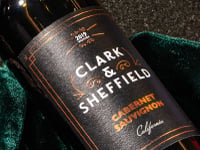
Yeah. Our Sonoma County Cabernet. Cool.
Is this the one?
Is this the 17 or is this the 16?
This is the 16.
So, I talked to somebody before, somebody from Old Forrester, and we asked her how long she had been working there, and she's like four years. And that's when it struck her that the bourbon that she had made is actually just coming to market now.
Correct.
So, I can't imagine there's that many jobs that you don't really have to put up until like three or four years after you show up.
But it's also challenging because now, when you first start in some of the wines that you're talking about, while you might have been involved in, you didn't actually get a start with the grapes. And so, there's challenges on both sides.
You're a little bit impatient because you want your babies out in the market, but at the same time, you get, you have to be able to talk to the other wines effectively as well. So, this is 2016, our Sonoma County Cabernet.
You're allowed to spit anytime. Sorry.
It is again, it's all about site. So, this is mostly Alexander Valley, a little bit of Dry Creek and even a little bit of Russian River.
How much Cabernet is there in Russian River?
Not as much as you think. Most of it grows up near the Dry Creek-Russian River boundary. There's a bench up there that has really beautiful reddish soils, that grows really great Cabernet.
Cool. That's where we would get ours from. It's similar to the really small amounts, but exceptional Cabernet you can find in the Carneros area of Napa, where we get really milk chocolatey beautiful qualities, really soft tannins.
It's quite good and sometimes that vineyard actually makes our reserved Cabernet too. It's called the River West Ranch.
Do you use any American oak?
In this wine, we use some American oak. That's actually gone away though, starting with the 2017 vintage that I stopped buying American oak and I started buying only French oak.
But yes, there's still a little bit of American oak in this and that's mostly cost focused.
Well, I think it's a good flavor thing too. I'm not anti-American oak at all.
Yeah, I mean some of the Grange and Silver Oak and Jordan until recently were all 100% American oak.
This is another example of a wine that's contained within itself. Nothing is exploding out of which I guess you could call integrated or round or polished.
Yeah, thank you.
Now, do you get to taste verticals of go back and taste like old Alexander Crown wines all the time?
Absolutely. Well, not all the time.
Well, sometimes.
Sometimes, yes. I just did one not that long ago, which was 76 to current, so almost 40 years of it. It was amazing.
I haven't filmed it because it was so cool.
I'm sure the cabs in the 70s, 80s, probably up until the early 80s, I mean, what kind of alcohol were they at?
Like 13, 13.5.
That's pretty surprisingly a little bit high. Were they American oak back then?
All American oak for the most part. I think the Crown might have been a little bit more French oak than some of the other ones.
Rodney was also a pioneer in the use of French oak in California wines, but I still think they were quite a bit of American oak. At the time, because of the success of the Heights Martha's Vineyard wine, we all wanted eucalyptus.
So there are stories of Rick in the back of a pickup truck throwing eucalyptus branches throughout the vineyard to try to get that flavor into the wine, because that's what we thought we wanted at the time.
Now, we realize that was crazy, and now we're cutting them all down. So just palate changes, perception shifts. So you can see almost the evolution of California wine when you taste a vertical like that.
Then I did it with Rick, one of the last things I did with him before he retired, and I could hear the stories and the explanations of everything.
I took just copious notes so I can look back on them later, because you have to glean that information when you have access to it.
Yeah, I was going to say, when you think about, look at how those wines were made, would you say now, that was crazy?
Well, no, it's fairly similar. We pick it differently. I believe in what's called physiological ripeness.
Back then, it was strictly based off sugar and acid. I'm making my decisions off taste more than I am analysis. I'm also more focused on acidity, the pH of the grape sample versus the sugar.
I can always fix the sugar later. We've shifted picking philosophy, but in the cellar, with the exception of precision, we have better refrigeration. We have cleaner cellars.
Philosophically, the fermentations are what they are. It's all natural, so we don't really control it other than with refrigeration.
Is global warming changing the balance of pH and tannic ripeness in sugars?
Not to the point where we could quantify it, but it's something that we're focused on. I would say global warming has had a bigger impact on drought. At least that's what we're attributing the last major drought to.
So we're doing things to protect ourselves, like including soil moisture probes in our vineyards now, so we can reduce our water usage, so the reservoirs we have will last longer.
We're trying to be less impactful, less synthetic additions to the fertilizers and pesticides and herbicides, using more natural ways of controlling that with the right cover crops, beneficial pests, lack of leafing.
Any certifications or just best practices?
No, we're a certified level 2 sustainable winery, and so that's the highest certification that you can get, and it's audited by a third party, so it's not just us tatting our horn. So we are actually a carbon neutral winery as well.
So what kind of wines outside of California are you passionate about?
I would say that I love French wines probably the most. Most of my friends are there, Burgundy and Bordeaux. I really like Rhone wines.
My Epiphany wine, I have a different term, but it has a curse word in it, so I can't say it.
We have Bleeps.
All right. So I call it my holy **** wine.
Yeah.
That is an Italian wine, Misedo, the 2001 Misedo in particular. And so I classify wines into three categories. I have your lifestyle wines and that's mostly what we're drinking today.
Those are everyday wines. You don't need any special reason to open that up just because you want a good glass of wine. Ego wines and those are wines that you have to impress people, to commemorate a special occasion.
And that would be our reserve tier or our rowan wines. And then there's that elusive category called the holy sh** wine category. And that is the wine that you drink that changes your perception of what wine can be.
It sounds weird that wine can be more than a beverage, but to me and to a lot of people, wine can be transcendent in some ways. And not every wine, but you can find that one bottle or maybe a couple bottles in your lifetime that will just...
You drink it and you say, holy s**t, that's the concept. And so every winemaker desires to make that one wine, and it's not for themself, it's somebody else's opinion, but most never do.
And so that's always our focus is to try to create that one wine that changes somebody's life.
So what was the vintage of the Macedo?
The 2001 Macedo.
So that's some age on it. I was going to say that I don't think you can... To me, I don't think you could have that in a young wine.
I think that that's one of the hallmarks of... I mean, aging brings can bring about... Correct, yeah.
It's real complexity.
Right. And so I had the privilege to drink that wine. So part of the reason that it had that effect on me was I drank it with the two winemakers that made it, Gustavo Gonzalez and Michel Roulon.
I did it in the context of style and philosophy, and I did it up against other wines that other people might consider to be in that category, like Petruss and Leonetti and all these great Merlots and Wright Bank.
See, you're already primed for a holy s*** moment.
That was sort of the concept. So I was in this tasting with Jean Vievre and Michel Roulon and Marc de Vier, who's a master of wine, and Gustavo.
So like some of the breast minds in winemaking, and I'm this young winemaker who really has not even traveled the world yet, so I didn't really even know what I was walking into.
Did you have to bring in any of your own bottles? No.
It was work, so they had arranged the tasting, and I still can remember it. I remembered when I put that wine in my mouth, I almost, it was like tunnel vision. I couldn't even hear anybody else talking.
It really just transcended everything for me, and I've always been focused on trying to create that. I've bought other bottles of maceda, which are delicious, but have never, just never achieved that for me since.
What's your holy **** wines?
1982 O'Brien.
Quick drama grat, you didn't even have to think about that.
No, that's my favorite wine of all time, and I've been lucky to have had it quite a few times.
In fact, actually a few years ago, when I was in Bordeaux for the en premier campaign, and one of our negotiations as a little like, it's actually a very informal get together for his English-speaking clients, and they always haul off really top
stuff, and he had six bottles of 82 O'Brien from their cellars. I probably hadn't had it in 15 years, so there was like, and I had to try every bottle.
Did you see variation?
Not very much, no. But these were all from the Nogos' cellars, which is in a very old, it's one of these couple of hundred-year-old Nogos' houses, and they're in a very old part of Bordeaux, and so the wine had never been moved, and it's terrific.
Something smells like that.
So it's funny you say that because that would probably, I don't know about that vintage, but O'Brien would be Rick, my predecessor. That would have been his choice as well.
We're tasting the Pinot Noir. Were you around, were you in the wine business when the sideways effect happened?
I was, yeah.
Yeah. What was it like?
Well, it sucks because I love Merlot. It's my favorite varietal, so I thought it got a bad rap. Although I feel more it got a bad rap because it was planted in the wrong spots than the sideways thing.
To me, it became an innocuous red wine and it stopped being Merlot. And so then people found other things that were more interesting, and that's kind of the reason it died off. Because the good Merlots are still good and they're still selling.
So, but yes, it was challenging. I always liked Pinot Noir, so I wasn't overly afraid or saddened by that it got popularity.
But what I was afraid of is, in my opinion, what I'm seeing today with Pinot Noir is like Mark West Black, which is not really Pinot Noir.
It's Pinot Noir blended with a lot of other stuff to make it big and black and juicy, which is not what Pinot Noir should be. So it's one of the reasons actually I came to Rodney Strong was because he planted Pinot Noir in 1968.
We've done it really good for a very long time, and I wanted to get experience with it without losing my passion for Bordeaux reds. So this gave me option for doing both.
Is this 100 percent?
100 percent, yeah.
Where did he first plant Pinot Noir? Was it in Russian River?
Russian River, yeah. We still own that site today. Today we call it the Jane's Vineyard.
Back in the day when he planted it, it was called the Garfield Ranch.
Speaking of dark Pinot Noirs, what do you think about having ingredient labeling on wine?
I'm for it. I mean, for us, it's great because ours would say grapes. So we're good.
It's simple. We don't add anything to our wine.
Nothing ever?
Ever. It would say grapes and sulfites. That's it.
That's all what ours would say. We're fine with it. We also provide calorie content and all that other stuff.
A lot of our national on-premise accounts require that for their menus. So we do all the work anyway. So it's easy and we would have no problem with it.
I'd be afraid of the calorie count.
Yeah.
Don't want to know.
I always couldn't figure that out really because the calories are coming from the sugars, but we've changed the sugars. I guess they're still alcohol sugars, but I don't know. They're not as important calories.
So you're talking about that national accounts need calorie labels.
This winery, back when I got started in the early 2000s working in a grocery store, it was an easy recommendation because of the consistency. Also, it's one of the more interesting wines that I could sell out of a grocery store.
Now, we work for Binny's and we have everything, but this brand that you're like a steward of now, do you feel like a responsibility of maintaining this almost ubiquitous presence, this historical level?
Absolutely. I totally respect and am excited about being able to lead Rodney Strong into the future. I have no intent to ever shift our classical style and our focus on place.
If I have my say, which I usually do, I'm sort of a prima donna in that sense, I would like to hopefully always stay focused on Sonoma County and focus on these classically style made wines.
My goal to improve is just doing it better tomorrow than we did today. I follow tons of people on social media, wine-focused people.
And every Saturday morning or Sunday morning, everybody posts that photo of all the dead soldiers that they drank the night before, right? There's that big lineup of all the empty bottles.
What I want to see every single day when I wake up and I see these 50 photos, I want to see Rodney Strong in at least 10 of those photos because it's a wine that they're drinking that now they want to brag to their friends that, look what I drank
last night. I drank Russian River Pinot from Rodney Strong. You see flowers and you see Patsen Hall and you see Litteri all day long. With due respect to our brand, we don't necessarily see us that often in those photos.
So I want to get us there. That's what I push for every single day, in a simple way to put it.
What's the coolest venue that you've seen your stuff?
Well, it's actually in a lot of really cool venues. It's in French Laundry, it's in Perse, it's in Levitt Madison Park. My favorite venue, though, was at the Poly de Marceau.
I went to Burgundy for the Poly, and not only did I bring some Rodney Strong, but I had given a gift to somebody, one of the winemakers at Raminet, and you bring your favorite wines to that event.
I'm not sure if you've ever been to it, but it's the best wine event in the world, period. And seeing my wine on that table with all those other wines was the best place I've ever seen.
Folks, that brings us to the Q&A portion of Barrel to Bottle, The Binny's Podcast, where we answer your questions on the podcast for a $20 Binny's gift card.
Email your questions to comments at binnys.com or hit us up on social media at Binny's Bev on Twitter, Facebook, and Instagram. Our question this week comes from Hannah, who asks, how can you tell when a batch of grapes is ready to harvest?
So there's a lot of things we look at. First and foremost, we want to see that the leaves of the vine are starting to turn. We have a little bit of yellowing when we look at the grape itself.
We want to see little dimples on the berry. We want it to taste really good. We want the seeds inside the berry to be brown.
We want the canes on the vine to be lignified or brown. All that tells us that that vine is physiologically mature. After that, we will look at analysis.
We'll look at sugar content and acid content. But more importantly, and the most important thing is that it tastes yummy.
So science and art.
Science and art. It's always a balance.
You heard it from the winemaker himself. Hannah, I hope that answers your question. $20 Binny's gift card coming to you.
Everybody else can email your questions to comments at binnys.com or hit us up on social media. Binny's Bev on Twitter, Facebook, and Instagram. Justin Seidenfeld.
Thank you.
Did I say it right again?
You did.
Two for two.
Again, I internet stalked you last night, watched videos, so.
Thank you.
You outperformed yourself here today, I got to say.
I appreciate it. Some of them are like some of my first videos, so they're not very good, but I'm getting better.
Yeah, man. So, all right, you spent all day in the vineyard doing soil analysis, tasting wine, doing scientific analysis, asking for somebody to design earthquake-free wine cellars, and yet you also have to be a PR guy.
A little bit. That's the role of a wine maker these days.
Everything. You have to come to the schlubby lincolnwood Illinois to be on a podcast for a liquor store.
I'm happy to be here.
You guys are such a big supporter of ours, and you guys even bought my auction lot a couple of years ago, my asymmetry, which was, I can't tell you how many people asked me for that wine still today, so I wouldn't be in any other place.
That's worth putting a tag on. Barb, how many auction releases do you actually pick up on that style?
How many auction lots I've purchased?
Yeah, it's not that often, right?
Yeah, well, I went to the three of them, and I've missed the last two years, so we've had about maybe about 10 auction lots. Yeah.
So that's cool for listeners.
Barb, our wine buyer, ever modest, actually goes to California, tries all of these different things, and then competes against retailers and restaurateurs and private collectors across the country to bring stuff that she actually finds super
It's super small, so it's 10 cases total, and that's all there is.
Once it's gone, it's gone and it'll never be made again.
Is it gone?
No, we do have a little bit left.
Oh, man. It's almost like a fire sale.
And every bottle signed by me, so there you go.
Cool. Act fast, folks. Otherwise, give these wines a try.
It's classic, timeless examples of California wine making in an international style. It's pretty cool to see at a price that, you know, it's kind of hard to say no.
Thank you so much.
I'm not wanting to sound like an advertisement for your stuff, so.
Well, we appreciate that because all the help is needed. It's such a competitive market with not just California, but the rest of the world that, you know, we bow down to people that help us.
This has been terrific. Thank you for your time. We'll be backing your feed in a week.
Until next time, I'm Greg.
And I'm Barbara.
I'm Justin. Keep tasting.